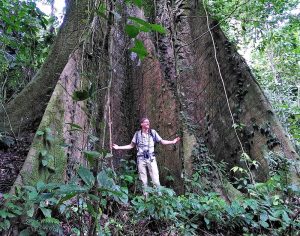
The Ceiba tree, also called kapok tree, is an impressive sight with its trunk full of thorns and a growth rate of 2 to 4 meters per year. Those thorns allow the tree to protect itself from all kinds of animals. The tree is one of the forest giants of the tropical rainforest and grows up to 70 meters tall. The thickest Ceiba tree ever measured is in Brazil with a circumference of more than 30 meters. The tree rises so high above the rest of the rainforest that its branches provide another habitat for a variety of plants that need more sunlight. In commercial coffee and cocoa plantations, the Ceiba is used to create shade.
Moreover, the tree has quite a history, as it has existed since before the continental drift so we can find it from Mexico to South America, as well as in West Africa and pieces of Asia. The tree has branches only at the top, where they spread out like an umbrella. During the flowering season, moths and bats are attracted to its abundant nectar production. For example, the tree makes up to 10 liters of nectar per night! In Cambodia, they have manipulated the tree so that it has low branches and a smooth trunk. They use the fibers in the fruit, also called silk cotton, as padding for mattresses, pillows and life jackets, among other things. The bark, leaves and stems are also used medicinally to treat acne, rashes, toothaches, rheumatism and burns. Western science is also beginning to show interest in the tree and research its medicinal properties. Inaddition,theseedscanbeusedasabiofuel.
Spiritual value
Not surprisingly, people throughout the ages have looked at this tree with admiration. For the Maya, for example, this tree was of great spiritual value, you can find the ‘ya’ax’che’ in many Maya artworks. For the Maya, this tree was the connection between the 3 levels: the underworld, our world and the different levels of heaven. Even more, they believed that the tree held up the sky with its branches. The tree was also a good indicator of favorable habitat, since they only grow near good water sources.
The indigenous inhabitants of Costa Rica also place great spiritual value on this tree. Unfortunately, this is much less well documented. But the story goes that they placed their loved ones who had recently died at the base of the tree by the roots, offering the soul a stairway to heaven.
In the reserve
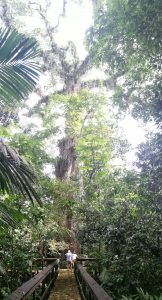
Also in the reserve of Adopt Rainforest are some enormous Ceiba trees. Any tourist or student who comes into contact with a Ceiba tree for the first time is silent for a few seconds and stands staring upward in wonder. But even for the guides, it remains a magical moment to encounter such an impressive forest giant in the middle of the jungle.
The thickest Ceiba in Costa Rica has a circumference of 22.55 m and is called Arbol de la Paz, the tree of peace. ItstandsinVolcanTenorioNationalPark.
Despite the fact that there are no students because of the Corona crisis, the research continues (partly).
In the Netherlands, some students are busy analysing data, but also in Costa Rica inventories are still being made. Accompanied by guide Tapa, Hanneke and Maarten walk the transects in different habitats.
Last week we had the pleasure of welcoming professors Edwin Pos and Yann Hautier of Utrecht University to our project in Costa Rica. It was a week entirely dedicated to local collaborations. Our project managers Maarten and Hanneke together with the professors visited different organizations in Costa Rica to strengthen existing collaborations and initiate new ones.. (more…)
Stichting Adopteer Regenwoud’s research project is entering an exciting new phase thanks to a long-term collaboration with Utrecht University. The foundation was ready for a new step to professionalize the research project and Utrecht University was looking for a stable and reliable partner in Central America to conduct solid research in the rainforest. So for both parties this is a wonderful collaboration! Because of this we will make a big step in professionalizing our current research on biodiversity in our reserve. Together with the visiting students we will focus on scientific research in which the diversity and development of nature in our reserve, with an emphasis on flora, is central.
Humanity has cleared countless acres of forest over the centuries. But not all forests are the same. Sure, a forest in Costa Rica has trees and squirrels, just like a forest here in Europe. But while we can certainly draw comparisons between our temperate forests and tropical forests, there are many differences. In this blog post, we take a closer look at why tropical rainforest logging is even more disastrous and how the consequences extend much further. And logging is certainly ongoing. Globally, the tropics lost 4.1 million hectares of primary forest in 2022, 10% more than in 2021, the platform Global Forest Watch reported.(more…)
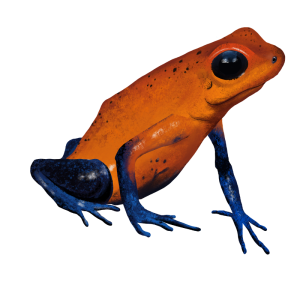
In Costa Rica, you can’t ignore them: the Oophaga pumilio. Pumilio means dwarf, and although they are barely 3 cm tall, it is hard to miss the poisonous strawberry frogs. In English, they are called Strawberry Poison Dart frogs because indigenous peoples used to use their poison to makepoison darts. They are also affectionately called the “blue jeans frog,” because they often look like red frogs in jeans. Although they are by no means all the same colors. There are some that are completely red or blue, rather yellow, green or orange, or with black stripes or dots. In total, there are some 15 to 30 color variations.
If you are about to stay at Adopt Rainforest in Costa Rica, you will definitely meet one of the project’s key people: Gerald. This smiling young man whose age no one really knows, will help you find your way in the jungle forest and will teach you how to use a machete. He knows just everything about trees and insects and if you’re lucky enough to be Dutch, he can even hold a conversation with you in your native language. Gerald is a discreet person who has made himself indispensable: in the garden, or in the jungle he always finds his way.
Let’s start right away with a fun fact: Costa Rica covers only 0.3% of the Earth’s surface, but you will find almost 5% of the world’s flora and fauna species! Per area, Costa Rica has the highest biodiversity in the world!
This beautiful blue butterfly, measuring up to 15-20 cm, seems to appear and disappear with every flick of its wings. In fact, its underside is a clever trick of Mother Nature. On the underside, it is inconspicuous reddish-brown, with eyes to deter attackers. The bright iridescent blue, in turn, is to deter competition and attract females.
Critically endangered parrot species Yesterday the research program of Adopt Rainforest participated in the Censo Internacional de la Guacamaya Verde 2022. Or in English the International Sensus of the Great Green Macaw. Throughout its distribution, dozens of organisations participate in the next days to get an understanding of the current state of this parrot species. […]
Did you know… in the wet months the frogs in Costa Rica show themselves more often? They are less prone to drying out because of the wetness and are singing because many species lay their eggs in the rainy season. Earlier we talked about the glass frogs, but there are many more frogs to be seen in this period. (more…)
What is deforestation anyway? This term is used to describe the process by which trees give way to agriculture and livestock. Deforestation takes place in large numbers every day, especially in the Amazon rainforest. Not a pretty thing! The consequences? Cutting down trees not only means loss of our beautiful nature and biodiversity. It has an effect on the ambient temperature: it rises. This increase is caused by burning trees and because oxygen (O2) gives way to carbon dioxide (CO2) emissions. Trees store a lot of CO2 and this is released during deforestation. The numbers? Don’t be alarmed: around 13 million hectares of forest disappear on Earth every year, according to the FAO. To make it a little more tangible: this equals 18,207,280 football fields. Approximately 34 soccer fields per second! (more…)
Is it possible to restore the original rainforest in a deforested area where cows have been grazing for years? In Costa Rica at least they accept the challenge. This article tells in short how a Dutch foundation in Costa Rica is trying to transform degraded land back into a fully fledged rainforest. (more…)
Nature lover and birdwatcher Nienke recently visited the breathtaking rainforests of Costa Rica. In the coming period, she will recount her experiences in vivid detail in a series of stories. Enjoy reading this second blog! There is something magical about discovering a foreign country, a feeling that you are on the verge of something bigger […]
With green plants that originated in the tropical rainforest. By: Annemarie Silkens Costa Rica is known for its amazing flora and fauna, especially in the rainforests and cloud forests. Costa Rica‘s plant world is very extensive and varied. Over 12,000 different plant species (of which more than 1200 species of orchids!) are found. Climate, soil […]
Most species are between 7.5 and 13 cm in size. You would almost think it is an out-sized bumblebee! Hummingbirds (Trochilidae) are the smallest birds in the world. They are a family of birds of the order swift-like. The family includes more than 300 species. Most species are found in South America. It is so much fun (more…)
In the spring of 2023, there was suddenly an opportunity to go to Costa Rica for Adopt Rainforest. I was also in Costa Rica a year earlier and there someone tipped me off about an organization of two Dutch guys who were working to protect and restore the rainforest. When I got home I decided […]
When a butterfly flies by, most people do stop for a moment to follow it with their eyes. They often have beautiful colors and the large soft wings compared to the small body make them look almost cuddly. In Costa Rica there are more than 1200 species of butterflies and of course we are very curious about the species that occur in the reservation of Adopt Rainforest.
In the Caribbean lowlands of Costa Rica most rain falls in May to August. The fact that it rains is good for all life of course, but can be quite difficult for our biologists in the Work with Nature reserve; the paths become muddy, the laundry doesn’t dry and the project is sometimes briefly inaccessible because rivers are filling up. (more…)
What’s with the fur? Why do sloths sleep so much? This month, the three-fingered sloth is the animal of the month at Adopt Rainforest. And what’s more fun than hearing from one of the founders of Adopt Rainforest some fun facts that you won’t find in a standard biology book. Maarten van der Beek is one of the biologists at Adopt Rainforest and lives on the Work With Nature reserve in Costa Rica. (more…)
Discover our special partnership with the Bromelia Specialist, where passion for the Bromelia plant and the conservation of Costa Rican rainforest come together. For three years, the Bromelia Specialist has supported the work of Adopteer Regenwoud in protecting the origins of the Bromelia plant, while providing Europe with the most beautiful Bromelia products. Behind the […]
From 25 hectares of grassland to a thriving rainforest
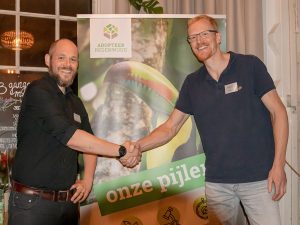
This month chairman Martin and founder Matthijs were at Trees for All’s headquarters to ratify a new cooperation for reforestation of 25 hectares of grassland. One of the largest projects in Costa Rica for the Adopt Rainforest Foundation to date. A total of more than 27,500 trees will be planted. (more…)
Do you want to offset your CO2? But have no idea how CO2 offsetting works? In this article we will tell you all the ins and outs about CO2 compensation so that you can reduce your CO2 emissions and offset them in the right way.
Over the past year, documentary filmmaker and dedicated foundation volunteer Bram Sturm and his crew have worked hard on a remarkable new project: Eufonia. The result is a unique and intimate glimpse into the life of Gerald, who works in the rainforest reserve of Adopteer Regenwoud. We were already deeply impressed by the outcome — and now the Wildlife Film Festival Rotterdam has confirmed it: the film has officially been selected! A truly special achievement that we’re excited to share with you.
What is sustainability and why is it important? Sustainability is a much-used word, for example, sustainability can have a meaning in relation to the environment and climate, but it can also have a social and economic meaning. Because it is such a broad concept, it can be quite difficult to properly understand what sustainability actually […]
In recent years we have already seen many rare and unusual animals in our reserve such as the Northern Nacked-tailed Armadillo, Black-and-White Hawk-Eagle and several felines. However, what we recently encountered is many times more interesting to scientists. In 1989, Epigomphus houghtoni, the Limon Knobtail, a dragonfly species was described by Stephen Brooks based on […]
We all know how important trees and plants are for producing oxygen and absorbing CO2. Especially lately there has been a lot of news about the climate crisis, global warming, sea level rise, CO2 offsetting and the importance of preserving trees, plants and forests. In this blog you can read some background information on how trees store our CO2 emissions.
In 2023, the foundation launched a large-scale reforestation project at the reserve in Costa Rica. The goal: to restore 25 hectares of deforested area – former pasture land – to original tropical rainforest. Thanks to the efforts of nine local workers and with the support of Trees for All, as many as 25,000 native trees were planted! These trees continue to be carefully maintained. We are enormously proud of the impressive growth that is now visible. In this video we take you through the progress of this special project. (more…)
Now that student Sonny, a pure night tour specialist, is about to finish his internship, a lot of great discoveries are made at the last minute. To top it all off, last week we found a special glass frog in the reserve. This Hyalinobatrachium dianae – Diane’s Bare-hearted Glass Frog was only discovered and described […]
Last summer we were able to open the proverbial champagne bottle again! Despite all external influences, we managed to formalize the purchase of a beautiful and especially strategically important piece of rainforest! It concerns the 9 hectares on which the research center is located. (more…)




 In the reserve
 on with Utrecht University. The foundation was ready for a new step to professionalize the research project and Utrecht University was looking for a stable and reliable partner in Central America to conduct solid research in the rainforest. So for both parties this is a wonderful collaboration! Because of this we will make a big step in professionalizing our current research on biodiversity in our reserve. Together with the visiting students we will focus on scientific research in which the diversity and development of nature in our reserve, with an emphasis on flora, is central.